| Catalog No. | HV826013 | ||||
| Brand | abinScience | ||||
| Host species | Alpaca | ||||
| Species reactivity | Human | ||||
| Form | Liquid | ||||
| Storage buffer | 0.01M PBS pH 7.4 | ||||
| Purity | >95% as determined by SDS-PAGE. | ||||
| Clonality | Monoclonal | ||||
| Isotype | VHH-8His-Cys-tag | ||||
| Applications | ELISA, IF, IP | ||||
| Target | TMS1, CARD5, Caspase recruitment domain-containing protein 5, Apoptosis-associated speck-like protein containing a CARD, PYD and CARD domain-containing protein, ASC, PYCARD, hASC, Target of methylation-induced silencing 1 | ||||
| Purification | Purified by Nickel column | ||||
| Endotoxin level | Please contact with the lab for this information. | ||||
| Accession | Q9ULZ3 | ||||
| Stability and Storage | Use a manual defrost freezer and avoid repeated freeze thaw cycles. Store at 2 to 8°C for frequent use. Store at -20 to -80°C for twelve months from the date of receipt. | ||||
| Reconstitution | Reconstitute in sterile water for a stock solution. A copy of datasheet will be provided with the products, please refer to it for details. | ||||
| Clone ID | SAA1187 | ||||
| Product Usage Information |
|
||||
| Note | For research use only. |
Anti-Human ASC/TMS1/PYCARD Recombinant Nanobody (SAA1187)
Overview
Images
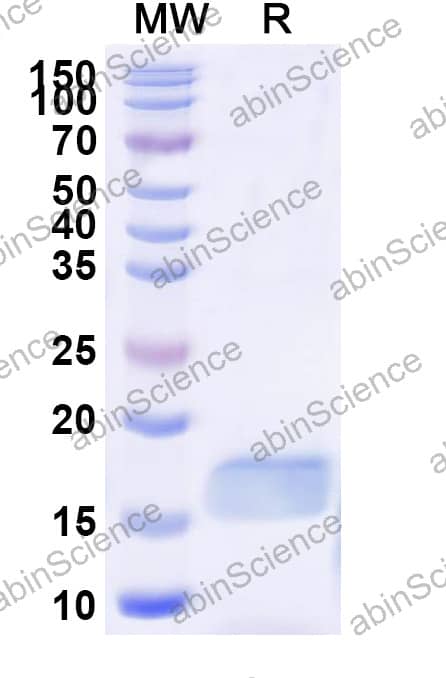 SDS-PAGE |
SDS-PAGE for Anti-Human ASC/TMS1/PYCARD Nanobody (SAA1187) |
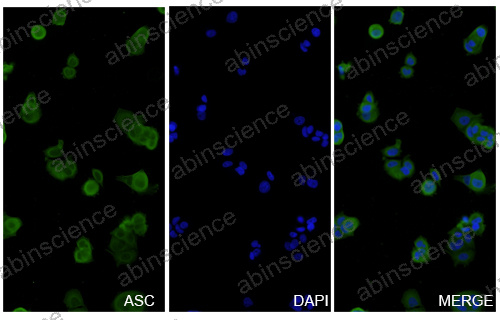 Immunofluorescence |
MCF7 cells were fixed with 4% paraformaldehyde for 20 minutes, followed by blocking with 5% goat serum for 1 hour. The cells were then incubated with His-tagged ASC protein (HV826013) at a concentration of 20 µg/mL overnight at 4°C. After washing, the cells were incubated with an anti-His primary antibody for 1 hour at room temperature, followed by incubation with Goat Anti-Mouse IgG (Alexa Fluor 488) for 50 minutes at room temperature. The localization of IDE was visualized (shown in green), and nuclear DNA was stained with DAPI (shown in blue). |