| Catalog No. | HB015026 |
| Brand | abinScience |
| Host species | Human |
| Species reactivity | Human |
| Form | Liquid |
| Storage buffer | 0.01M PBS pH 7.4 |
| Purity | >95% purity as determined by SDS-PAGE. |
| Clonality | Monoclonal |
| Isotype | IgG |
| Applications | ELISA, Bioactivity: FACS, Functional assay, Research in vivo |
| Target | TP103, Dipeptidyl peptidase IV, ADABP, Dipeptidyl peptidase 4, CD26, DPP4, Dipeptidyl peptidase IV soluble form, Dipeptidyl peptidase IV membrane form, DPP IV, ADCP2, Adenosine deaminase complexing protein 2, ADCP-2, T-cell activation antigen CD26 |
| References | 1. Hayashi M, et al. A humanized anti-CD26 monoclonal antibody inhibits cell growth of malignant mesothelioma via retarded G2/M cell cycle transition. Cancer Cell Int. 2016 Apr 30;16:35. [HB015026] 2. Yamada K, et al. Nuclear localization of CD26 induced by a humanized monoclonal antibody inhibits tumor cell growth by modulating of POLR2A transcription. PLoS One. 2013 Apr 29;8(4):e62304. [HB015026] 3. Ohnuma K, et al. Inhibition of Middle East respiratory syndrome coronavirus infection by anti-CD26 monoclonal antibody. J Virol. 2013 Dec;87(24):13892-9. [HB015026] |
| Purification | Protein A/G purified from cell culture supernatant. |
| Biological activity | YS110 (0-250 ug/mL, 48 h) inhibits cell proliferation in a concentration dependent manner in NCI-H2452 cells [1]. YS110 (2 ug/mL, 24 h) leads to a significant increase in the proportion of G2/M phase and affects the expression of related proteins in NCI-H2452 cells [1]. YS110 (2 ug/mL, 6-24 h) elevates activating phosphorylation of p38 MAPK and ERK1/2 in NCI-H2452 cells [1]. YS110 (0-20 ug/mL, 48 h) inhibits cell growth of JMN cells in a dose-dependent manner [2]. YS110 (0-4 h) relies on the caveolin pathway to induce CD26 nuclear translocation in JMN cells [2]. YS110 (2 ug/mL, 3 h) significantly inhibits the mRNA and protein levels of POLR2A in JMN cells [2]. YS110 (10 ug/mL, 30 min) effectively inhibits MERS CoV S1-Fc specific binding to CD26 in JKT-hCD26WT cells [3]. YS110 (40 ug/mL, 30 min) significantly reduces MERS CoV infection rate in Huh-7 cells [3]. Cell Proliferation Assay [1] Cell Line: NCI-H2452 cells Concentration: 0, 0.1, 2, 10 and 250 ug/mL Incubation Time: 48 h Result: Inhibited the cell proliferation of NCI-H2452 cells. Cell Cycle Analysis [1] Cell Line: NCI-H2452 cells Concentration: 2 ug/mL Incubation Time: 24 h Result: Significantly increased the proportion of G2/M phase cells with an average increase of 8 %. Western Blot Analysis [1] Cell Line: NCI-H2452 cells Concentration: 2 ug/mL Incubation Time: 6 and 24 h Result: Significantly increased the level of p21, p-cdc2, p-cdc25C, p-p38 MAPK and p-ERK1/2. RT-PCR [2] Cell Line: JMN cells Concentration: 2 ug/mL Incubation Time: 3 h Result: Significantly reduced the mRNA level of POLR2A. Western Blot Analysis [2] Cell Line: JMN cells Concentration: 2 ug/mL Incubation Time: 3 h Result: Significantly reduced the protein level of POLR2A. YS110 (5 mg/kg or 5 ug, intratumoral injection or i.p., three times per week) can significantly inhibit tumor growth in NOG mice bearing JMN xenograft [1]. YS110 (8 mg/kg or 10 ug, intratumoral injection or i.p. |
| Endotoxin level | < 10 EU/mg |
| Expression system | Mammalian cells |
| Accession | P27487 |
| Stability and Storage | Use a manual defrost freezer and avoid repeated freeze thaw cycles. Store at 2 to 8°C for frequent use. Store at -20 to -80°C for twelve months from the date of receipt. |
| Alternative name | YS110 |
| Clone ID | YS110 |
| Note | For research use only. Not suitable for clinical or therapeutic use. |
Anti-Human DPP4/CD26 Reference Antibody (YS110, RUO)
Overview
Images
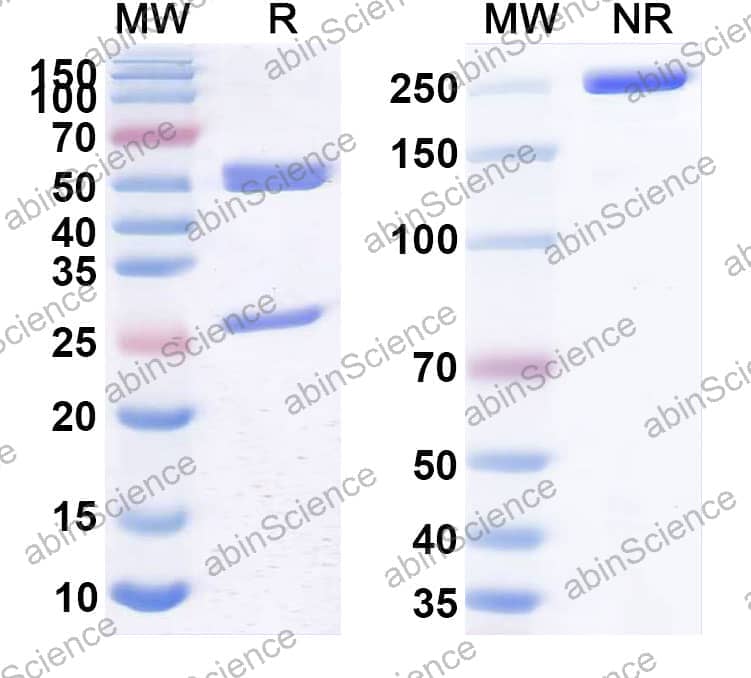 SDS-PAGE |
SDS-PAGE for Research Grade Anti-Human CD26/DPP4 (YS110) |