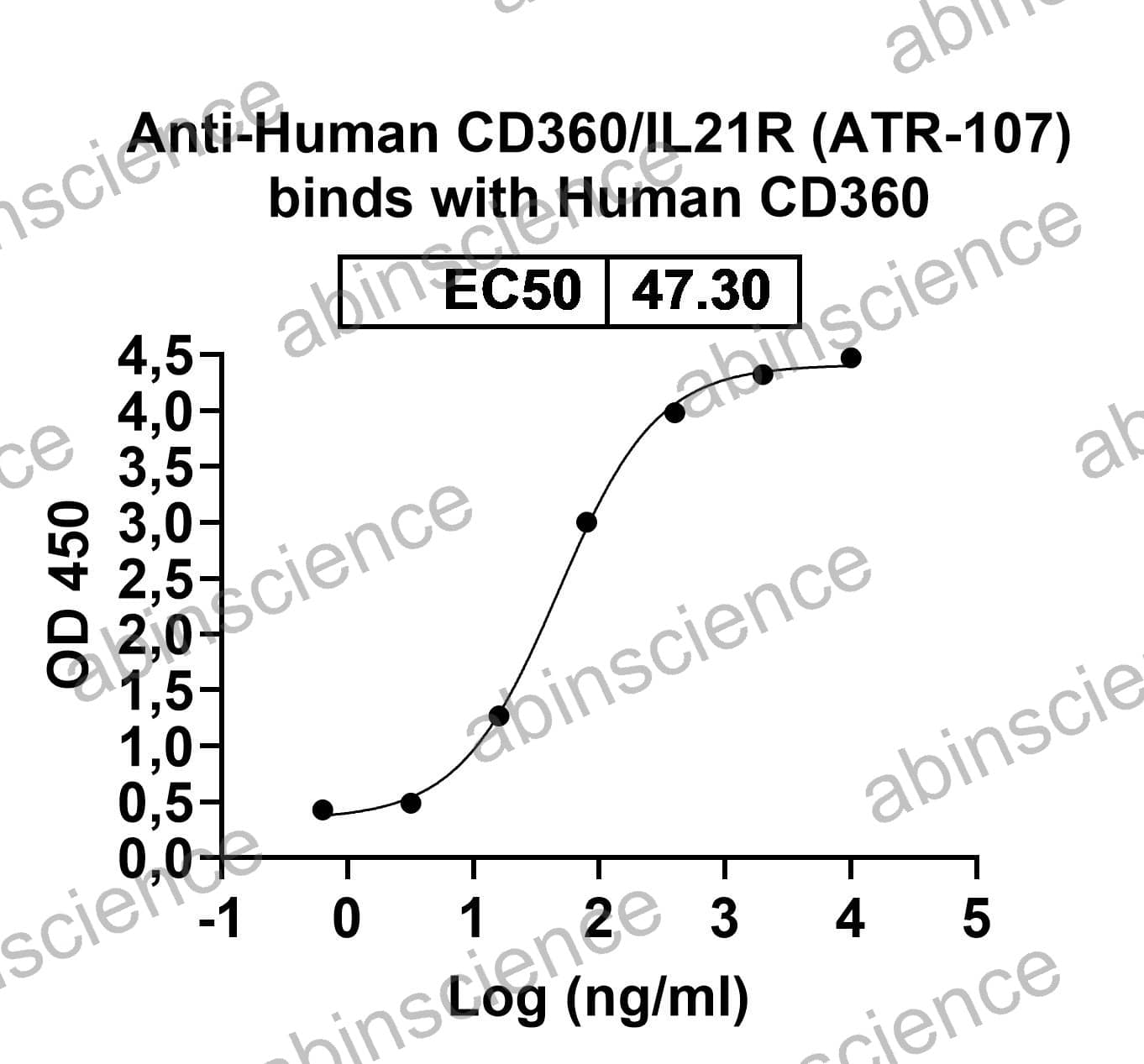
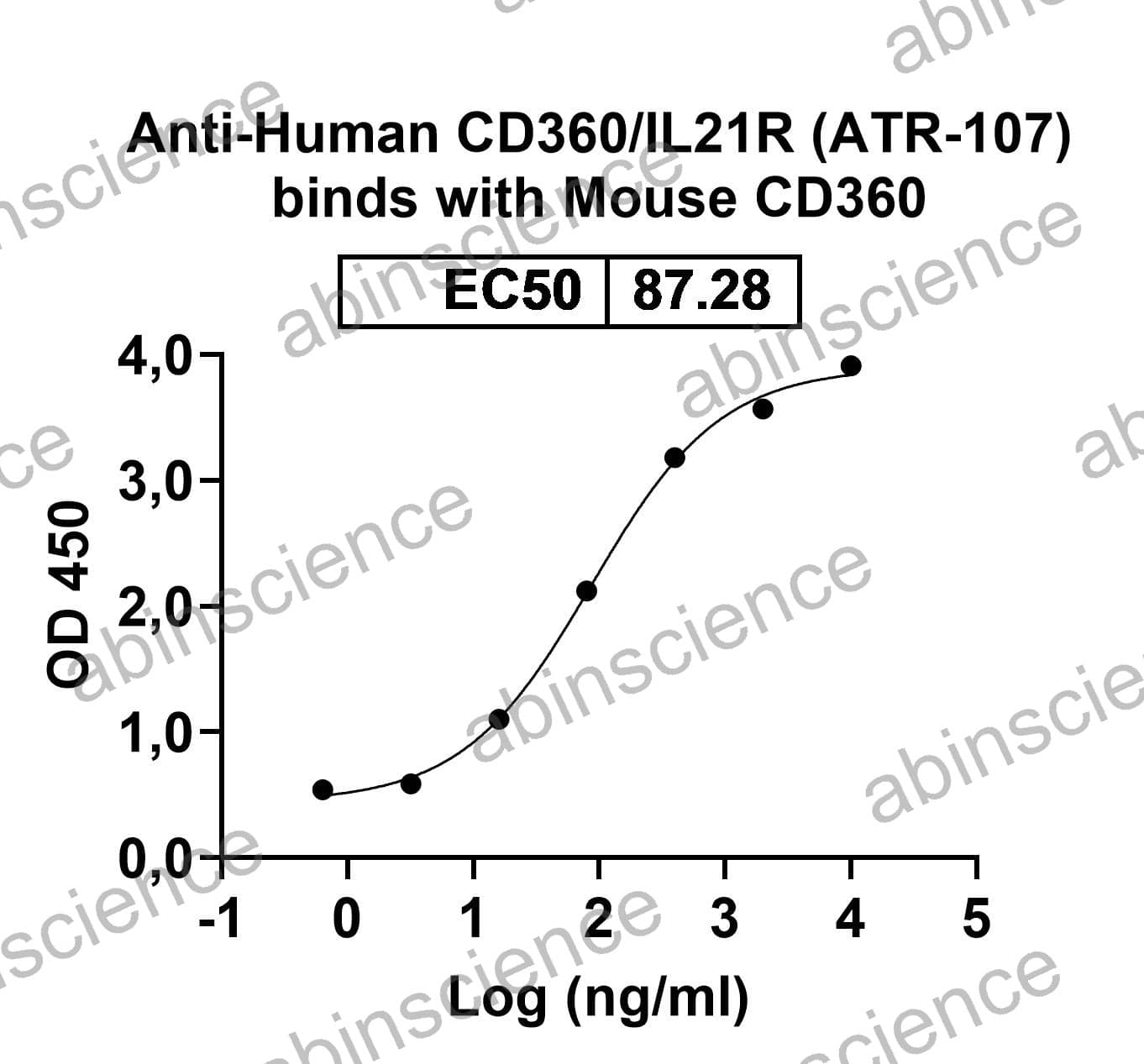
| Catalog No. | HV076026 |
| Brand | abinScience |
| Host species | Human |
| Species reactivity | Human, Mouse |
| Form | Liquid |
| Storage buffer | 0.01M PBS pH 7.4 |
| Purity | >95% purity as determined by SDS-PAGE. |
| Clonality | Monoclonal |
| Isotype | IgG1-lambda |
| Applications | ELISA, Bioactivity: FACS, Functional assay, Research in vivo |
| Target | IL21R, NILR, Interleukin-21 receptor, IL-21R, IL-21 receptor, CD360, Novel interleukin receptor |
| References | 1. Hu W, et al. Immune-Mediated Liver Effects Associated With Administration of a Human Anti-IL-21 Receptor Antibody (ATR-107) in Rats. Toxicol Pathol. 2024;52(5):232-250. [HV076026] 2. Tsai WK, et al. Nonclinical immunogenicity risk assessment for knobs-into-holes bispecific IgG 1 antibodies. MAbs. 2024;16(1):2362789. [HV076026] |
| Purification | Protein A/G purified from cell culture supernatant. |
| Biological activity | ATR-107 (100 ug/mL; 24 h) induces a significantly higher DC 50 internalization index than bevacizumab and a significantly lower index than bococizumab in human monocyte-derived DCs, consistent with its high clinical anti-drug antibody incidence [2]. ATR-107 (50 ug/mL; 7-day total incubation, with BrdU added for the final 24 h) induces significant CD4 + T cell proliferation in human PBMCs, with a positive response rate in ~30% of healthy donors, consistent with its high clinical anti-drug antibody incidence [2]. ATR-107 (100 ug/mL; 16 h (MAPPs assay)) has 11 in silico-predicted immunogenic T cell epitopes, 9 of which overlap with MHC-II-associated peptides detected via MAPPs, indicating a high potential for T cell-mediated immunogenicity [2]. Parmacokinetics Species Dose Route AUC 0-t Rat [1] 10 mg/kg i.v. 1893 ug·h/mL Rat [1] 50 mg/kg i.v. 27203 (M),18633(F) ug·h/mL Rat [1] 250 mg/kg i.v. 101165(M); 132003(F) ug·h/mL Rat [1] 250 mg/kg s.c. 14777(M);7256(F) ug·h/mL ATR-107 (10-250 mg/kg; i.v., s.c.; weekly; 13 weeks) causes immune-mediated liver injury (necrosis, bridging fibrosis, elevated liver enzymes) in Sprague-Dawley rats only at 10 mg/kg weekly i.v. after ≥3 doses; ADA presence alone is insufficient for liver injury, as 100% ADA incidence occurred with 10 mg/kg s.c. (no liver injury present), indicating the effect is route-dependent [1]. ATR-107 (1-10 mg/kg; i.v.; weekly; up to 4 doses) induces liver injury in female Sprague-Dawley rats that requires ≥3 weekly i.v. doses, correlates with high ADA titers, and causes transiently elevated liver enzymes with microscopic changes morphologically consistent with the 13-week study findings [1]. ATR-107 (0.1-10 mg/kg; i.v.; weekly; 3 or 4 doses) does not cause liver injury in female nude rats, indicating that a functional immune system (and resulting ADA formation) is required for the liver effects observed in immunocompetent Sprague-Dawley rats [1]. ATR-107 (0.1-250 mg/kg; i.v., s.c. |
| Endotoxin level | < 10 EU/mg |
| Expression system | Mammalian cells |
| Accession | Q9HBE5 |
| Stability and Storage | Use a manual defrost freezer and avoid repeated freeze thaw cycles. Store at 2 to 8°C for frequent use. Store at -20 to -80°C for twelve months from the date of receipt. |
| Alternative name | ATR-107, ATR107, ATR107 |
| Clone ID | ATR-107 |
| Note | For research use only. Not suitable for clinical or therapeutic use. |
Anti-Human IL-21R Reference Antibody (ATR-107, RUO)
Overview
Images